: , , , , , , , , , and
Art & Exhibitions
A Sole Cypress
through August 29 · Nardeen Srouji
Schedule
Details
The cypress broke like a minaret, and slept on the road upon its chapped shadow, dark, green, as it has always been.
- Mahmoud Darwish
Two cypress trees stand at the entrance to the Center for Contemporary Art building. The metallic structure, with its postmodern architectural language, and the pair of evergreens, form the point of departure for Nardeen Srouji’s (b. 1980, Nazareth) exhibition. Through them, the artist reflects on the place in which she is exhibiting, the land on which it stands, and the surrounding historical, political, social, and physical layers — houses and building materials, neighborhoods that have been erased, traces that have been assimilated into the landscape, ornamental motifs, and vegetation.
The exhibition spans the gallery’s two spaces and includes a site-specific installation and embroidery works. On the first floor, Srouji presents a reconstruction of the building’s façade, which enters the gallery space, tilted on its side as an architectural relic, temporary décor, or the frame of a building not yet completed or already collapsed. The building’s light, industrial materiality also echoes the Harat al-Taneq (tin shack) neighborhood, which was located between Manshiya and Kerem HaTeimanim until the mid-20th century, near the end of HaCarmel Street — an area that now serves as a parking lot for marketgoers. A temporary space of shacks and sheet-metal structures that has disappeared from the urban fabric, yet whose traces continue to resonate through the materiality of the CCA building itself.
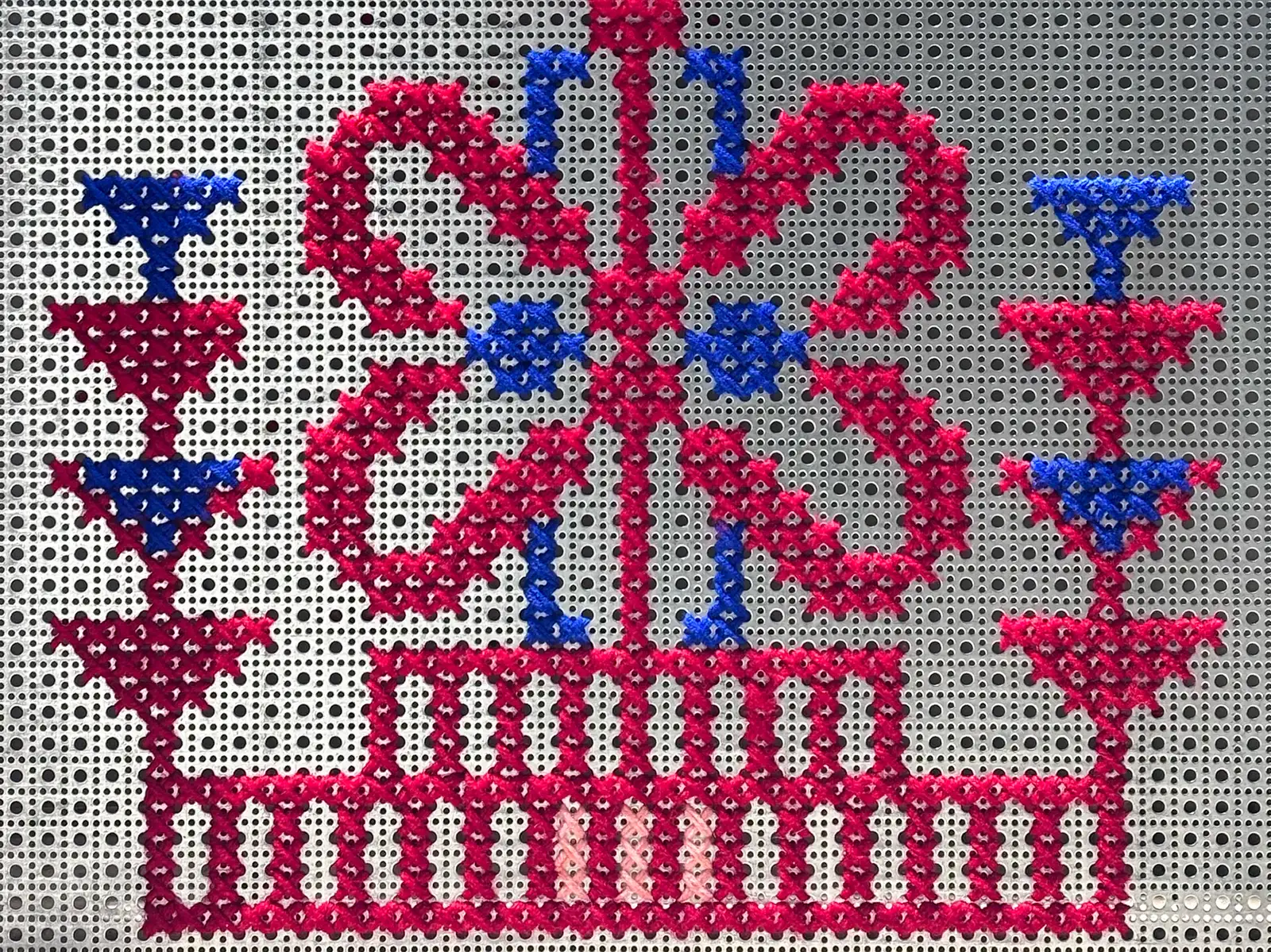
On the exhibition’s second floor, Srouji presents a body of embroidered works on metal surfaces evoking mashrabiyyas, another architectural element that she draws from the CCA building. Installed along the stairwell, they protect the windows from the southwestern sun. In recent years, Srouji has been working with traditional Palestinian embroidery patterns — a coded visual system of signs and symbols, a material language that has been forgotten over the years. Each motif carries information: about the origin of the woman wearing it, her family affiliation, her economic status, at times even her age or marital status. Embroidery is not mere decoration; it is a means of identification, a mobile archive, a language of place. Srouji returns to these symbols, but does not reproduce them nostalgically. Her embroideries are not sewn onto dresses and fabrics, but onto industrial metal plates, and even woven into the building. Srouji stretches, deconstructs, disrupts, and reassembles these embroideries. She reframes them in the present, while also exposing the structures concealed in them.
As a starting point for the new series of embroideries, Srouji observed the image of the cypress in Palestinian embroidery, as well as the urban-oriented array of symbols associated with Jaffa (Yafa). Alongside the olive tree, the cypress is a key image in Palestinian culture. It marks a place and the boundary of a plot. It is often planted in cemeteries, perhaps because, already in Greek mythology, it was associated with the figure of Cyparissus, who fell into deep mourning after accidentally killing his companion stag and, overcome with sorrow, was transformed into a cypress tree. The cypress’s vertical shape, narrow as a spear and resembling a flame, recurs in Palestinian embroideries and textiles in many variations.
Mahmoud Darwish, in his poem "The Cypress Broke, " describes the tree that collapsed onto the road, while life around it continues: people pass by, attempting to interpret its fall, account for it, assign meaning or blame. In the face of all these efforts, however, the poem concludes with the words: "The cypress broke, and that is all there is to it: the cypress broke! " As in the poem, in Srouji’s exhibition the collapse does not emerge as a singular or dramatic event, but as a part of an ongoing process: the Center’s façade seems on the verge of collapse, while the slow, repetitive act of embroidery penetrates beneath its surface, trying to heal, weave together, and construct an old-new image.