:
Art & Exhibitions
Mother of Otherness, Eat Me, Umm al-Fahm, through September 30
through September 30
Schedule: Mother of Otherness, Eat Me, through September 30
Details: Mother of Otherness, Eat Me, through September 30
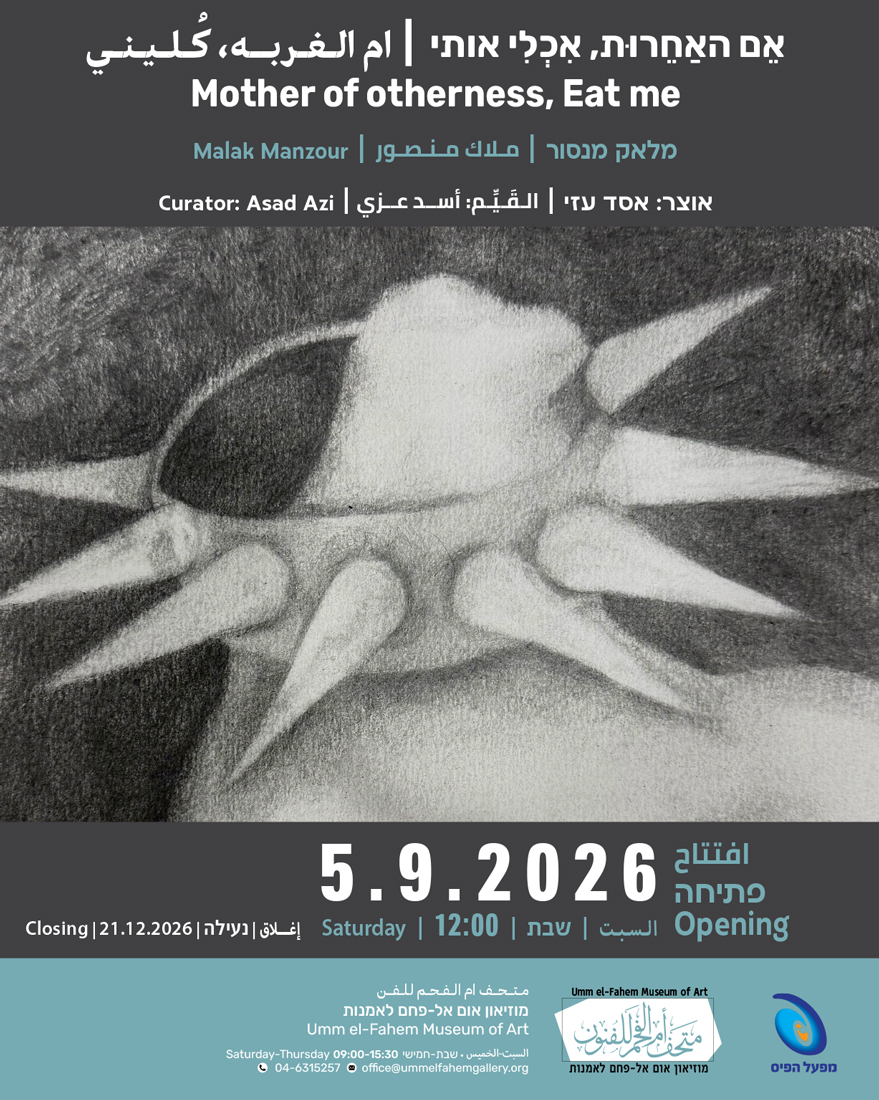
Mother of Otherness, Eat Me
Malak Mansour: "I seek to understand the world, to connect with the navel of the Great Mother. To do so, I turn to unconventional materials and a different visual language, hoping that the viewer will experience the very same journey that I do."
Malak Mansour brings forth visual treasures from the depths of the subconscious and from inner, personal, archetypal, and universal human realms — complex worlds veiled in feminine and human enigmas, as ancient as time itself and yet profoundly relevant today.
At the heart of a complex installation, suspended from the ceiling, hangs a form resembling either the tangled roots of an ancient tree or the soft tentacles of a jellyfish. It creates a human-scale dome that envelops the viewer, at once protective and threatening. This primordial entity functions as a temple or a sanctuary — not in a ritualistic or religious sense, but in a primal emotional one. It becomes a cosmic realm of wisdom, presiding over a rich constellation of fragments and small objects both within and beyond its boundaries.
Malak presents the world as a miniature galaxy. Its various components are emphasized and magnified, while the relationships of dependence between them are charged with tension — caught between belonging and the desire for separation, between control and the impulse toward detachment and independence. These dynamics are expressed through shifts in scale, center and periphery, proximity and distance, legibility and disruption, as well as through a range of visual, material, and textual elements.
Although the objects appear autonomous and self-contained, they remain inextricably connected to the monumental object at the center of the space — the Great Mother, Mother Nature, the Cosmic Womb. Each element may have been created independently, yet all exist within the sphere of the maternal entity that governs the installation.
This rich universe of images is metaphorical, reflecting the realities of existence within the embrace of the mother, the family, and society. Malak seeks to point to this condition, to critique it, and to propose in its place an alternative world embodied by Mother Nature: an embrace that is nurturing, supportive, constructive, and empowering, rather than castrating and paralyzing.
The viewer is drawn into the great dome, where they may sense the warmth of the primordial womb — embracing, protective, and compassionate — while simultaneously becoming its captive, enclosed within it. In both states, the viewer observes the surrounding world like a conscious infant, experiencing its mystery and its inscrutability. Signs and symbols emerge from every direction: owl’s legs, scales, distorted human figures, surreal black-and-white drawings, internal organs, and strange, unfamiliar materials that render the experience enigmatic and unsettling. The artist’s practice resembles that of an alchemist, intimately familiar with the hidden properties of materials and the concealed mysteries of the world.
The viewer is confronted not only with this reality but also with what is revealed through the openings between the roots: images, objects, drawings, and texts — fragments that exist beyond the planet, within the surrounding space. Even the seemingly neutral gallery itself becomes part of the installation, every architectural protrusion and fixture woven into its layered fabric. The exhibition space, too, belongs to this cosmos.
The exhibition as a whole is the result of an evolving and ongoing process through which Malak attempts to present the world from a surprising, personal, feminine, and original perspective. It is an effort to break away from the classical image of the mother and, above all, from conventional modes of deciphering, interpreting, and describing the world. The viewer is invited to become flesh of her flesh and blood of her blood, to enter her world, to become one of its living organs, to engage in a visual, emotional, and mental dialogue, and ultimately to become an integral part of her being.
Curator: As’ad Azi