: , , , , , , , , , and
Art & Exhibitions
One Hundred Twenty Drawings After Hilla and Bernd Becher, Tel Aviv
through September 5 · Noam Reshef, Eti Namir
Schedule: One Hundred..., Artspace Tel Aviv, through September 5
Details: One Hundred..., Artspace Tel Aviv, through September 5
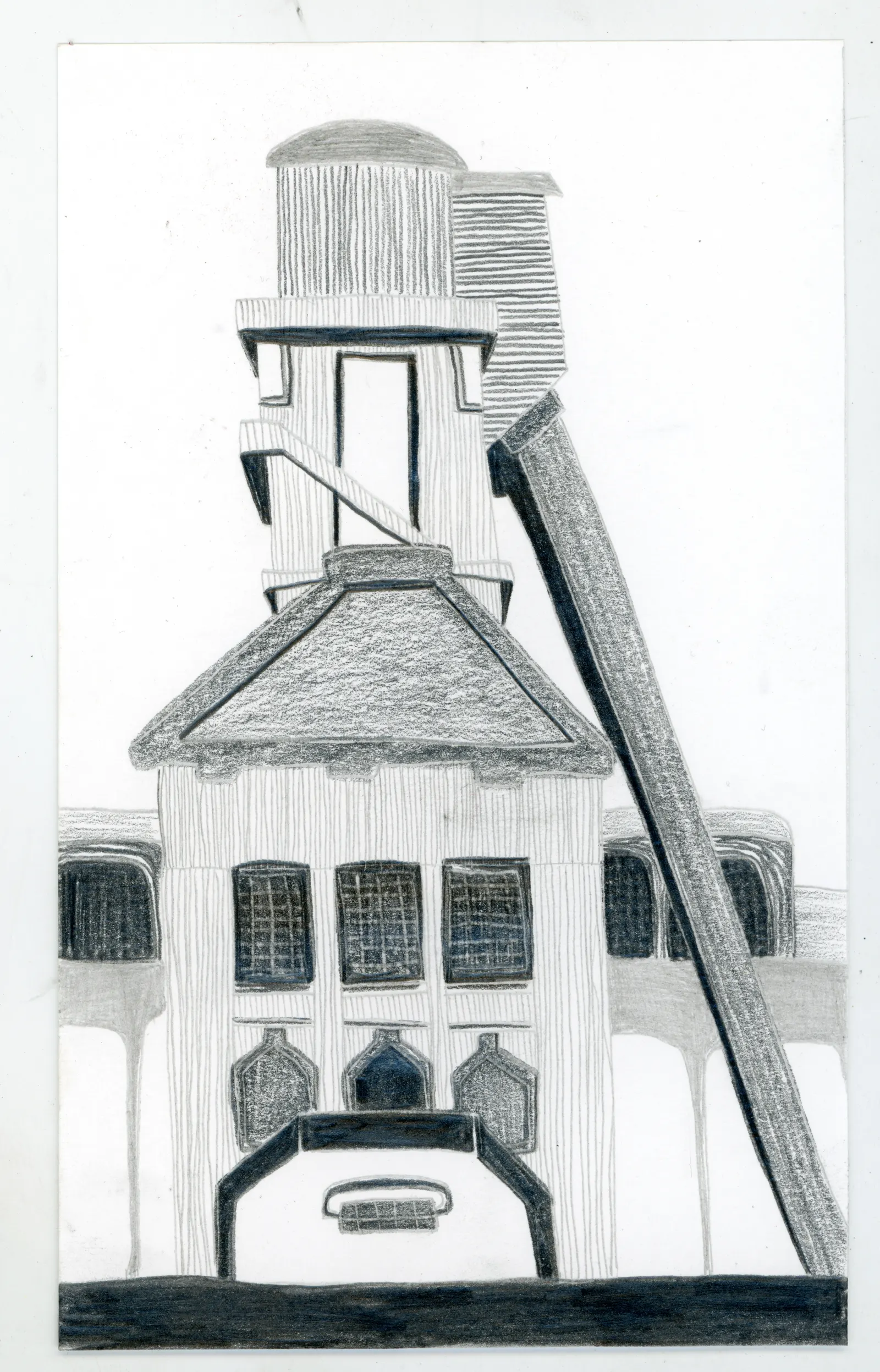
While the photograph concludes the act of looking, in Noam Reshef’s work it serves as its point of departure. One Hundred Twenty Drawings emerges from the photographs of Hilla and Bernd Becher. Reshef returns to the photographic image, lingering over it and transporting it from the medium of photography to that of drawing; line by line, the structures are redrawn – from the photographic image to the traces of the artist’s hand.
Hilla and Bernd Becher are among the formative figures of the new typological photography. Their photographic series, shot in the exact same way and displayed side by side, allow the eye to move between the photographs and reveal the singularity of each structure through comparison. For nearly five decades, the Bechers documented water towers, blast furnaces, winding towers, and other industrial structures, establishing repetition and systematization as both a formal and a methodological principle. Thus, utilitarian buildings designed solely to serve a purpose were elevated to the status of “anonymous sculptures” – forms with a sculptural presence that invite a renewed gaze at the built environment.
Reshef returns to a historic archive of images, from which she embarks on the act of drawing. She selects photographed structures from Hilla and Bernd Becher’s book, transforming them one after another into drawings. While in the Bechers’ work repetition is generated through photographic seriality, in Reshef’s practice it is embodied in the line itself. The structures do not take shape from a single contour but from the consistent accumulation of fine, dense lines, through which the form gradually materializes. Each line maintains its independence, yet their accumulation allows the structure to emerge. Here too, meaning is produced through repetition – not in the multiplicity of images, but in the cumulative time of the drawing.
The one hundred and twenty drawings are displayed in an orderly grid of eight rows, spread across the wall as a single unit. The small scale creates a sense of intimacy, inviting the viewer to approach each drawing individually and, at the same time, to step back and experience the series as a whole. The oscillation between a close-up look and an all-encompassing view sets observation as an integral part of the work. The installation emphasizes the order, rhythm, and precision at the core of the series, allowing each image to exist as an autonomous unit within the entirety.
The exhibition also features a 1987 film documenting Hilla and Bernd Becher at work. While the photographs present clean and isolated structures, the film reveals the actions that preceded them: clearing vegetation, cleaning the surrounding area, and an uncompromising attention to photographic conditions. Its presence in the exhibition adds another layer to the reading of the drawings, exposing the level of intervention required to create an image that at times appears natural and objective, as if it were a given.
Noam Reshef’s exhibition does not seek to recreate the work of Hilla and Bernd Becher, nor to reinterpret it. It offers an extension of their work from a different time and through the physical act of drawing. The drawings do not replace the photographs, nor do they merely transfer the image from one medium to another; they open another possibility for looking at them, and as such, formulate a visual language where fine lines re-weave the structure until it once again emerges from within the drawing itself.