: , , , , , , , , , and
Art & Exhibitions
The Neighborhoods Beneath the Grass, through December 30
through December 30 · Shlomo Har-Paz
Schedule: The Neighborhoods Beneath the Grass, through December 30
Details: The Neighborhoods Beneath the Grass, through December 30
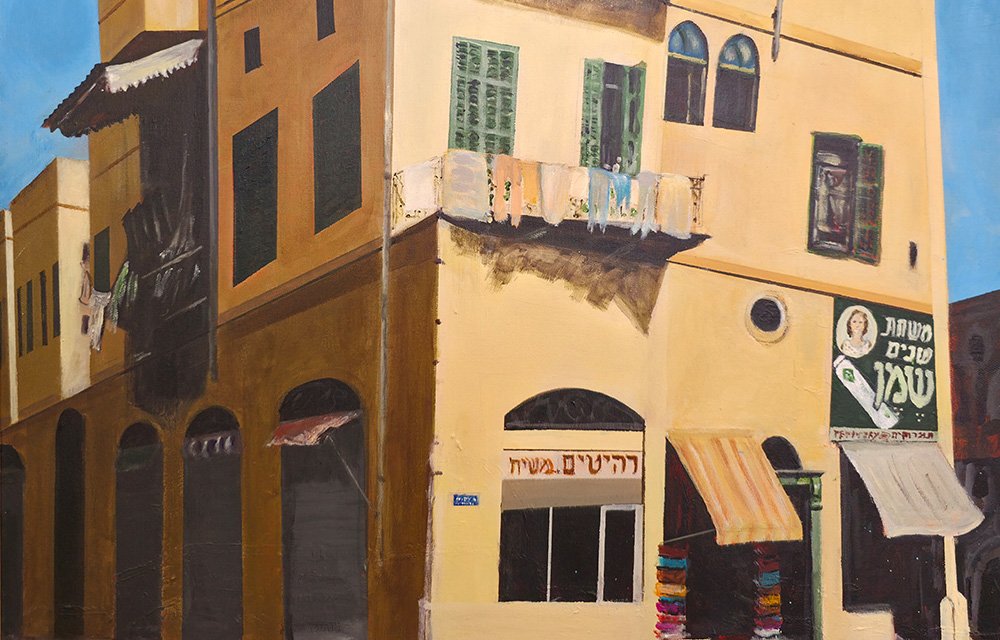
Beneath the lawns along the Jaffa coastline lie hidden neighborhoods. Streets that once led to the port, alleys that descended toward the water, houses facing the horizon — all erased from view. In this exhibition, painter Shlomo Har-Paz returns to his birthplace, to Jaffa before 1948; to the coastal neighborhoods, among them Manshiyya and al-Rashid, to the railway station, and to the houses that once faced the sea. Detailed Pilot-pen drawings and large-scale acrylic paintings restore scale, color, and presence to a space suppressed beneath the surface. The paintings are partly based on black-and-white archival photographs, yet the distinctiveness of painting, as opposed to photography, does not lie in reconstructing the historical past, but in its ability to combine imagination, memory, and emotion, and to create a free space for an imagined past, charged with stories that echo Shlomo’s personal and direct encounter with the alleys and port that shaped his childhood.
“I was born in Jaffa, and as a child I lived among the streets and houses depicted here. I was fortunate enough to touch them, to see the city as it was, and to experience life there — a city on the verge of the sea, alleys full of life, a busy port, and a bustling market. Through drawing and painting, I seek to connect viewers to the human experience of the place — to the sensation of walking through its streets, feeling the city, and experiencing it together with others. Line and color are my tools for bringing the city back to life, for remembering it through the eye and the heart.”
Perspective in Shlomo’s paintings operates on several levels simultaneously. On the visible level, it organizes the space — the streets, houses, and seashore — while at the same time allowing us to consider the relationships between place, time, and memory. In this sense, perspective is not merely a means of organizing space, but a framework through which to understand the relationship between the public and the personal. It is not simply a question of geometry, but also of experience, consciousness, and emotion. Decades separate the child who walked through the streets of Jaffa from the painter who returns to them today, yet within the painting they occupy the same space. Not as a reconstruction of a child’s gaze, but as an attempt to encounter once again the child who saw the city before it disappeared.
Several axes converge in the paintings, moving in different and at times opposing directions. Alongside the axis of time, moving between past and present, there is a vertical axis between what lies above the surface and the geological layers of the neighborhoods that were destroyed and buried beneath the lawns of Charles Clore Park. Each layer that accumulates does not erase the one beneath it; it covers it like a scar, allowing it to continue existing alongside the present.
Another axis operates on the conscious and political plane: what and who have been stifled from the story of the city and from its landscape. Not only in terms of physical space, but also in terms of the city’s human fabric, in which fishermen, camel drivers, and orange boats no longer exist. Next is an axis that moves between realism — expressed through meticulous attention to detail, searching in archives, and reconstruction from memory — and the fantastic and dreamlike. The drawings enter a world in which giant fish float above the city’s skyline and hidden skulls lie beneath the foundations of its buildings.
Shlomo uses painting as a tool of excavation, transforming it into an archaeological site — not one that reveals what was, but one that allows us to imagine what might have been. Painting becomes an act of resistance to forgetting. In a place where public space tells a single story and silences its own past, Shlomo allows different narratives and additional layers of existence to return. In this way, painting becomes a mechanism through which a place that has been erased can continue to exist even if it’s only in consciousness.