: , , , , , , , , , и
Выставки
Keseh, Dov Gallery, до 30 октября
до 30 октября · Итамар Бранд, Эфрат Натан
Подробнее: Keseh, Dov Gallery, до 30 октября
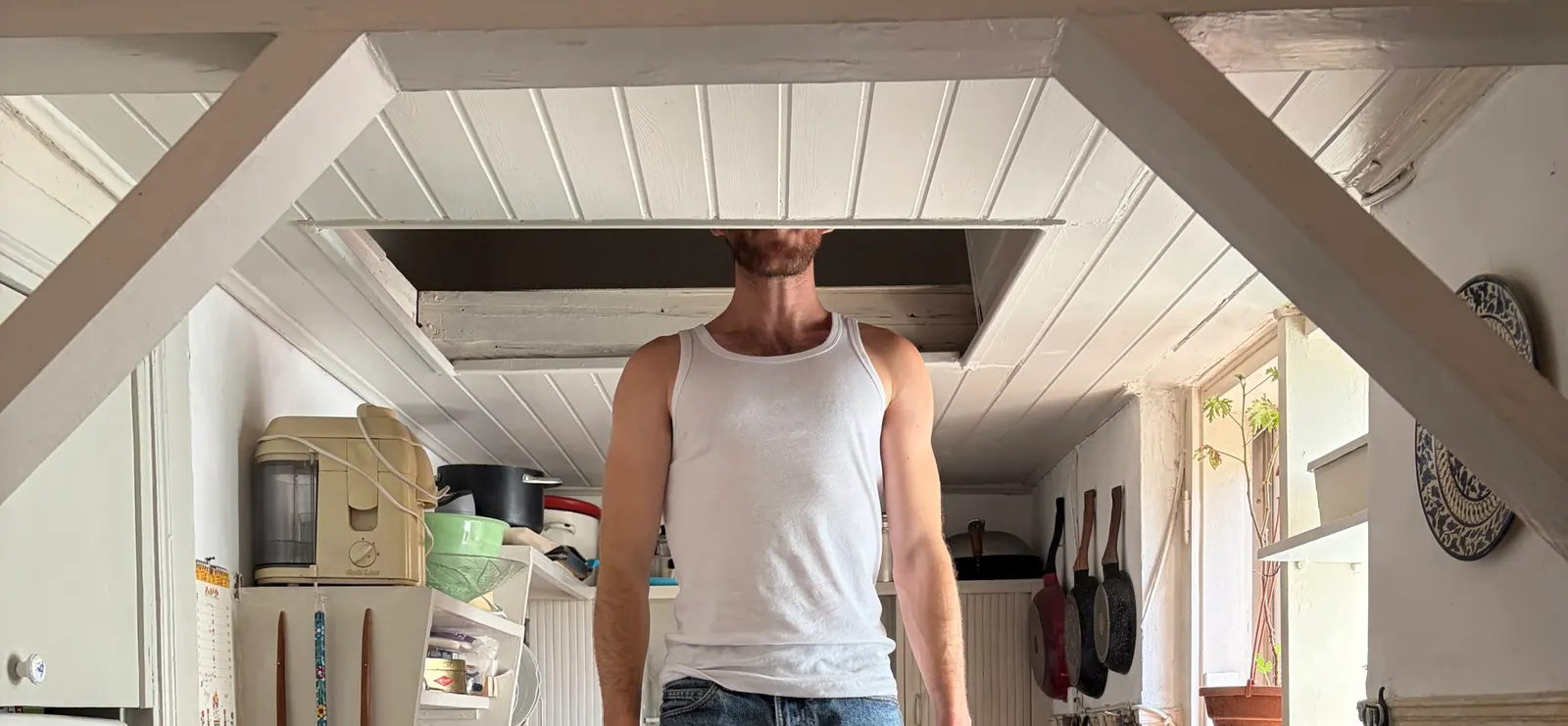
Efrat Natan and Itamar BrandThe encounter between Efrat Natan, a key figure in Israeli conceptual and body art, and the emerging artist Itamar Brand began with an action. Brand entered Natan’s apartment and thrust his head through a square opening in her kitchen ceiling, in the attic floor, as in her walking performance Head Sculpture (shown in the exhibition in two small photographs, from 1973 and from a 2021 reenactment). Brand does not treat Natan’s action as a source to be quoted. He turns it into raw material for a new bodily action in the present. Dressed in a white undershirt and biblical sandals, he does more than echo the undershirt, a quintessentially Natan-esque raw material, and the ancient Middle Eastern sandals, with their bond to nature and earth. He also creates a physical and expressive severance between the head, buried in the attic, and the torso and legs.And what happens when the head is detached for a moment from the body and legs, stuck in an attic or inside a head sculpture? Perhaps this is a proposal that speaks to our own situation today: to disconnect, if only for a moment, from systems of ideology, mythologies and collective rituals, and to reconnect with basic bodily actions, even premeditated ones, and in doing so to invent a new mythology, as art at its best knows how to do.And what will replace the missing head? One of Brand’s proposals in the exhibition is a hybrid of a human head and a donkey’s head: a “חמורני.” Brand’s donkey comes from the Messiah’s donkey, an image of passage from a world of matter (chamor, “donkey,” echoing chomer, “matter”) to a world of spirit, from the low to the sublime. The modern artistic counterpart of this, present in both Natan’s and Brand’s works in the exhibition, is the use of found objects: an object taken from the ready-made world, which gathers new meanings as the artist acts upon it, charges it and constitutes it anew. Here too, Natan’s works and actions serve Brand as raw material, which he takes, passes through his body, and endows with a new context and meaning.Alongside works based on readymades, Natan draws from her artistic attic early drawings that have not been shown before, which were part of the planning and thinking behind installations and body actions. Among them is a “Preparatory Drawing” for a vertical installation, low and high, that evolved into the installation Roof Work (1979), and another “Preparatory Drawing” from 1973 that eventually evolved into the photographed action Blanket and Youth (Speaking)(1974). In this drawing are nine sequential states of covering and uncovering the body of the artist herself, lying on her back, asleep or dead, covered with pieces of a thin blanket.“Keseh” is the exhibition name, whose opening date is the eve of Rosh Hashanah. It derives from the phrase “between keseh and asor,” which refers to the time between Rosh Hashanah and Yom Kippur. Rosh Hashanah is the only festival that falls, like every Hebrew Rosh Chodesh (new month), on a day when the earth casts its shadow on the moon, covering and concealing it. Covering and uncovering, disappearance and presence, are expressed in the exhibition through concrete actions that are also different manifestations of time.The exhibition space converts abstract concepts of time present in the two artists’ works, such as countings, festivals and rituals, into concrete actions and new manifestations of matter. Opening the exhibition on Rosh Chodesh (from the root ch-d-sh, “new”), at the beginning of Tishrei, which will bring October with it, for better or worse, gives the exhibition a distinct temporal dimension. This dimension emerged from a fruitful dialogue between two bodies of work, two periods and two bodies, a dialogue that moves between “Efrat Natan [lit. ‘Efrat Gave’] – Itamar Took” or between what has already been created and the possibility of making it anew.Aya Miron, Tel Aviv, 2026