: , , , , , , , , , и
Выставки
Woman to her Sister, Old National Library Building, до 11 ноября
до 11 ноября · Edna Ohana
Куратор: Nitza Perry
Расписание: Woman to her Sister, до 11 ноября
Подробнее: Woman to her Sister, до 11 ноября
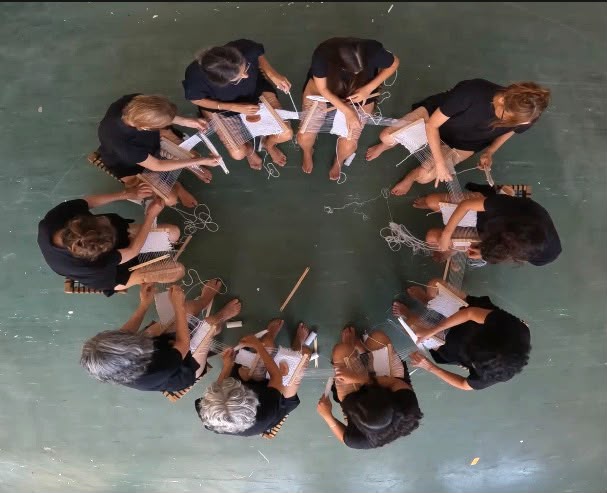
Ten women sit in a circle. Resting on the legs of each is a small loom, its parts attached to the body by white thread wound around the legs. Each woman connects her loom to the loom beside her, and together they form a single human loom: a living weaving system stretched between bodies, breaths, and movements. The loom is not an object placed upon the body; it comes into being through the very act of joining oneself to it. The weaving takes place in the space between body and material, in muscular tension, in the rhythm of breathing, and in the mutual dependence between the women. If one woman ceases, the fabric continues to exist through the shared responsibility that binds them together.
The title of the work is taken from the description of the making of the Tabernacle in the Book of Exodus: “The five curtains shall be coupled one to another.” Midrash Tanhuma adds a striking image: “And Bezalel would draw the forms for them, and the righteous women would weave upon their thighs” — women who quite literally carry the house upon their bodies. The work rereads these verses: not only curtains are joined, but women; not only material is woven, but time, memory, and community.
Alongside this collective action, Ohana transforms a book trolley, originally designed to carry books in the National Library, into a mobile loom bearing a textile yet to be woven. Within the trolley’s alcove, an intimate, solitary action takes place, directly extending a path that has accompanied Ohana’s work for years, in which the individual body served as a single loom. Here, the individual body expands into a social body; the traced line that once accompanied bodily actions becomes a structure of relations between women.
At the conclusion of the action, the women place the communal textile on the chairs and rise. What remains is not an assemblage of separate pieces, but a single circular construction: a woven ring in which each section is joined to the one beside it, until the boundary between one woman and another is erased. The textile remains as material testimony to a form of togetherness that is no longer visible, yet continues to exist within matter itself: wall, curtain, home.
In a fractured social reality, the work proposes an alternative edifice, one grounded in listening, support, mutual bearing, and shared responsibility – a woman to her sister.