: , , , , , , , , и
Выставки
Yonge St. Corner of Eli Cohen St, Ришон-ле-Цион, до 30 декабря
до 30 декабря · Doron Fishbein
Расписание: Yonge St. Corner of Eli Cohen St, до 30 декабря
Подробнее: Yonge St. Corner of Eli Cohen St, до 30 декабря
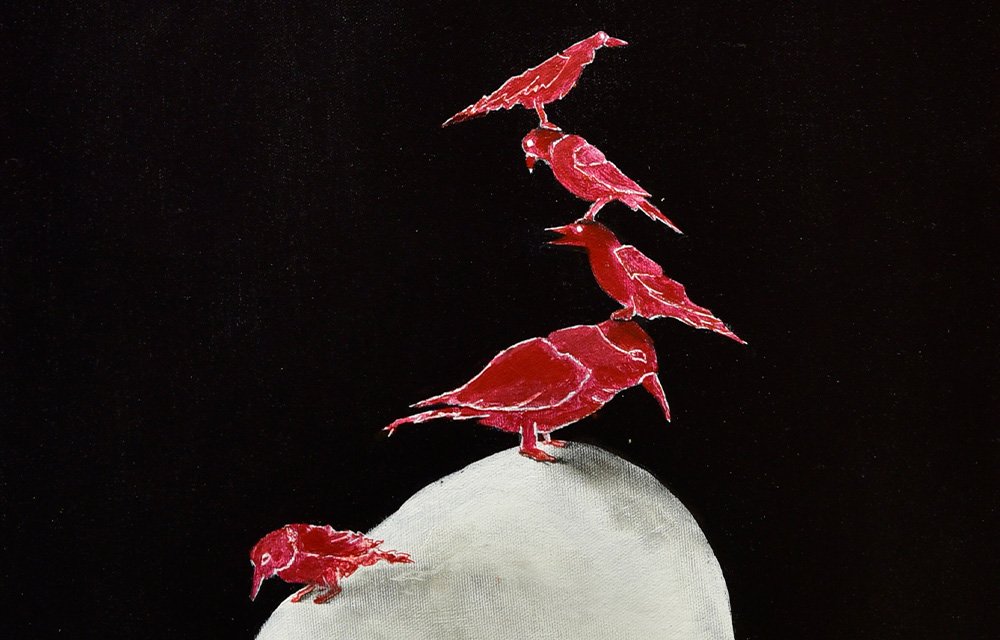
Different skies hover over Doron Fishbein’s paintings in the present exhibition. They are tangled, wider, and it seems that something in the scale and in the relationship between earth and sky from his previous paintings has shifted. Even the symbolic vocabulary that forms his recognizable syntax — the shelter, the prickly pear cactus, the buildings, and the moon above — suddenly expands to contain other images: deer, bare trees, unfamiliar birds, and frozen lakes, that speak in a foreign language.
The family’s move to Canada led Doron to the world’s longest street, that stretches across 86 kilometers, crossing a dense city, countless intersections, shopping malls, commercial centers and replicated, unremarkable buildings. The street navigates through the city’s physical space, but at the same time it is a microcosm that cuts across the city’s human and cultural diversity. It samples populations of immigrants and locals living along the edges of the endless street. The buildings appear as empty shells, replicated and generic façades, immersed in a dense fog that prevents any distinct sense of individuality and therefore extends toward infinity.
Doron combines elements from here and there, their juxtaposition highlighting a state of eclectic and dislocated culture. The gaps between the cold, open landscapes and the prickly pear cacti and public shelter underline a sense of foreignness, as well as the fears originating from the Israeli reality that follows the immigrant wherever he may wander. The images themselves become immigrants: the cactus is no longer simply a cactus, and the shelter is no longer just a shelter. The sense of estrangement produced by signs and symbols detached from their familiar context emphasizes the situation of Yonge Street, which functions as an axis linking together the social, cultural, linguistic, architectural, and spatial complexity of the Canadian city. The exhibition conveys a sense of an identity lost in an unidentified space, overflowing abundance of identical nothingness. The place gives and takes at the same time: on the one hand, countless possibilities lie open, all lead to a dead end; a place that is everywhere and nowhere, a paradox that stretches across 86 kilometers.
The works contain hints of an underground world unfolding beneath the surface, a visible world and a hidden one, both mirroring and following one another. The openings that resemble hunting pits that traps deer and wild animals, connect to the winding subway, speeding beneath the ground and replicating the path of the street above. It is not merely a transportation infrastructure, but a kind of subconscious current cutting through space. The exhibition moves between two states: endless movement and frozen stillness. The train moves along its route, the street stretches toward infinity, yet the landscape is frozen, the trees stand bare, and the sky weighs heavily above.
The street creates encounters between wild nature and human culture, as well as intersections that crosses mythological symbols such as the Golden bull and figures drawn from classical Greek ceramics, an ironic reminder of the fate that awaited the Hellenizes and those who worshipped foreign gods.
The exhibition crosses Yonge Street with Eli Cohen Street, in Doron’s childhood city of Bat Yam. This impossible intersection, between two streets that could never meet within any actual geographic space, can occur only within painting, creating a third space: neither here nor there, but a place formed from the tension between the two. For Doron, migration is not a movement from one place to another, but a permanent state of being “at the corner.” Between the Israeli landscape that travels with him and the Canadian landscape that will never quite fill like home. Painting remains the only place where the two worlds can exist side by side, and perhaps that it is the painter’s true homeland.